
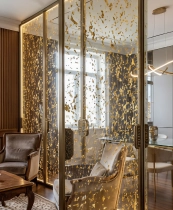
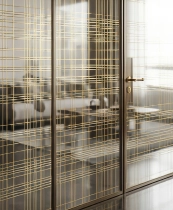
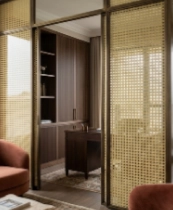
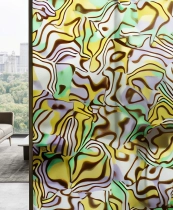
Glass is synonymous with illumination, transparency, spaciousness, and versatility. It can be used to make windows, of course, but also mirrors, tiles, mosaics, space dividers, and even flooring and stairs. Glass clearly has an important role to play in healthy building (no pun intended). There are a lot of factors to consider when specifying glass for a project. How can glass be sustainable? What should designers and other building industry professionals look for in a manufacturer? And where does glass come from?
To learn more, Knowledge Bank spoke with Goldray Glass’s Vice President of Sales and Marketing, Laura Little, and their Industrial Scientist, Prince Ruchogeza. Goldray Glass is a manufacturer of architectural decorative glass for interior and exterior applications. It’s a family-based company that was founded in 1985 in Calgary, Canada, where their HQ still operates today, supported by new generations of families who have worked at the company since the beginning. Goldray Glass is a member of the U.S. Green Building Council, the Canada Green Building Council, and the Health Product Declaration Collaborative, and the company is committed to continually improving the sustainability of its products.
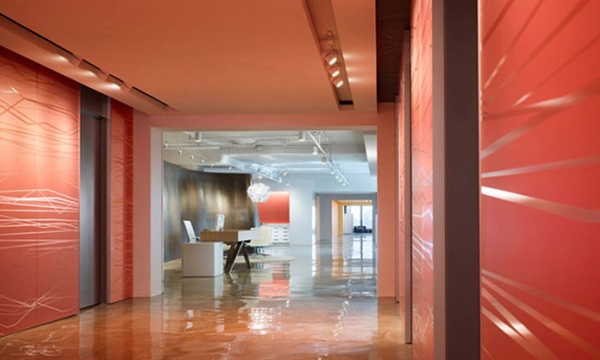
Reusable Wall Systems
Traditionally, glass wall cladding installations are glued directly to the wall or substrate. So in order to replace or remove a piece of it, Little explains, you’d need to break the glass, chisel it off the wall, throw it away, repair the dry wall or substrate, and then adhere the replacement. Goldray has developed an innovative wall system that allows for reuse: “You just pop the panels off the wall, pop another one in, and then you can reuse it at a different location,” says Little. “For example, we just installed a whole bunch of wall cladding in a significant transportation project, where they are deciding to add a public art component. Because of the interchangeable feature of the system, the project owners and designers are considering incorporating the art into the wall by replacing with new panels and reusing the ones taken out in another location..” Thanks to these kinds of systems, renovation and demolition can easily allow for the recovery of glass wall cladding.
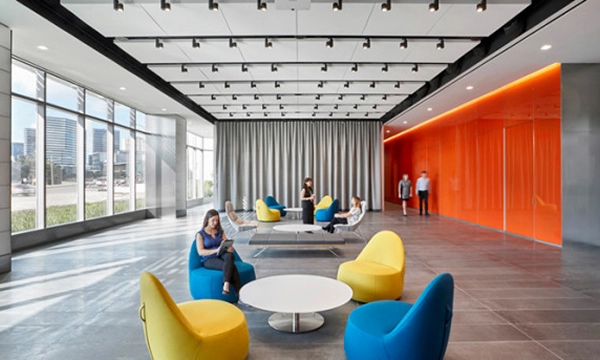
Sustainable Glass Manufacturing
While there’s no way to make glass for architectural applications without using sand and lots of heat, there are ways to make the process more energy- and resource-efficient. Little explains: “The glass comes to us in big sheets from the float factory where they recycle the excess glass trim from the ribbon and reuses the cullet to add back to the glass manufacturing process. The offcuts from our facility is recycled into materials for other products, like highway marking beads . It’s a process of eternal recycling.” Goldray, she tells us, has a software to maximize yield so that as much of each sheet is used as possible, and everything else gets recycled. “There’s literally been almost zero waste going into landfills.”
It’s simpler to recycle pre-consumer glass than post-consumer glass, especially if it’s been treated. Ruchogeza explains that only untreated glass – glass without mirrors, paint, or laminates – is recyclable, though Goldray and other glass manufacturers are trying to find a way to change that. Goldray’s clear glass, he tells us, is recycled into beads for use in reflective paint on roads and bike lanes.
One of the challenges for glass manufacturers is electricity and gas use. Because glass must be heated to such high temperatures, there are CO2 emissions. This doesn’t mean that manufacturers can’t still make significant improvements in their energy use. Ruchogeza tells us that at Goldray, they’re currently replacing all of their fixtures in their factory to reduced electricity use. “We are also trying to understand how much power we use at every location – our cutting line, our edging line, our tempering processes – to see how we can modify them to decrease the amount of energy we use.”
Certain processes are water intensive, but there are ways to recycle the water used. For example, the machines which create a polished edge on the glass uses water as a lubricant. Little explains that “built into those machines is the cleaning of the water that’s used so we can recycle it and use the same water over and over rather than it becoming waste water.”